
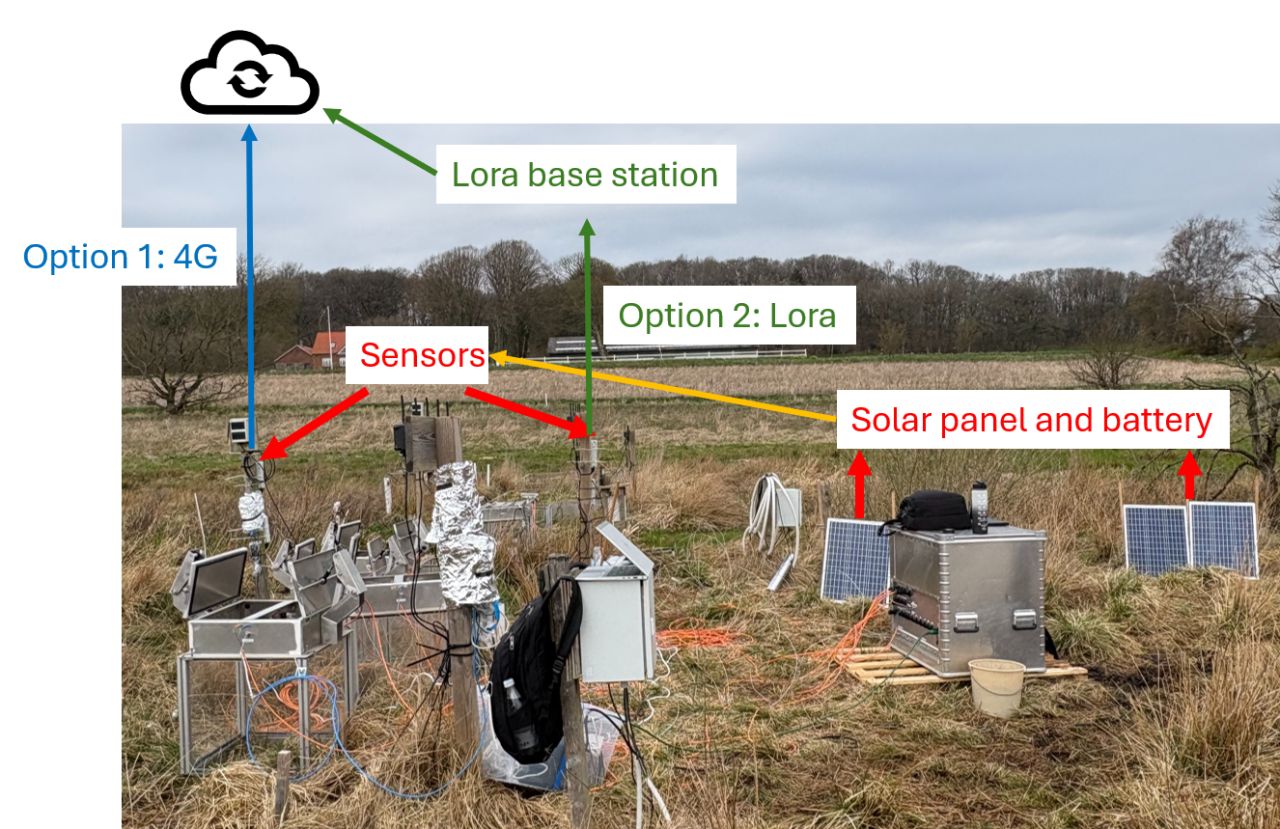
The MISO consortium has implemented the wetland pilot near Viborg, Denmark, to test the performance of the autonomous sensors for flux measurements under realistic ecosystem conditions.
In addition, the workflow of MISO (from measurements to data exploitation on data platform) was tested. In which, two end-to-end communication methods were applied to transfer data:
- LoRa-based communication: A LoRa gateway was installed as a base station to receive data from multiple sensor units deployed at the site.
- 4G communication: In parallel, the sensors also used 4G to upload data directly to the central data platform, enabling near real-time access and analysis for scientists.
Both communication methods operated fully autonomously, without human intervention, once deployed.
To ensure the sustainability of systems developed, we tested MISO system with integrated power supply , guaranteeing long-time series measurements.
The photo below shows the MISO sensors powered by a car battery combined with a solar panel. With this setup, the system operated continuously for over 2.5 months without on-site intervention, demonstrating the suitability of the platform for long-term deployment in remote wetland environments.