EGU26 provided an important opportunity to present ongoing work from the MISO project as it approaches its final phase, highlighting the scientific and technological progress achieved through strong collaboration across the consortium.
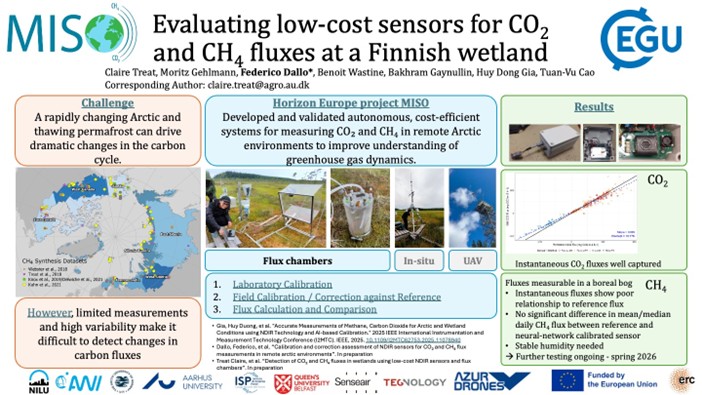
During the conference, our colleague Federico Dallo (ISP-CNR) presented the team’s work on integrating the K96 NDIR sensor prototype, developed by Senseair, into an automated flux chamber system designed by Claire Treat (Aarhus University) for monitoring CO₂ and CH₄ emissions in Arctic wetlands.
? ???? ???? ???? ???? ????????
• Integration of low-cost NDIR sensors into automated flux chamber systems
• Firmware optimization to reduce power consumption while ensuring temperature and pressure stability
• Calibration and correction methodologies to improve data reliability (developed in collaboration with ??? ????? ???)
• Wireless communication interfaces enabling local data acquisition and optional end-to-end cloud connectivity hosted at NILU, coordinated by Tuan-Vu Cao
? This application represents one of the three main use cases within the MISO project and contributes to the development of practical, scalable and cost-effective scientific instruments for environmental monitoring.
? The goal is to support more accurate carbon budget assessments in remote and climate-sensitive environments, including Arctic wetlands and thawing permafrost regions.
The transition from concept development to operational field deployment marks an important milestone and highlights the potential of low-cost, open and interoperable environmental monitoring solutions for the scientific community.