










Menu Close

Gas flux chamber for CH4 and CO₂ source sensing

Gas flux chamber for CH4 and CO₂ source sensing

Gas flux square

Current automated and manual gas flux measurement chambers for measurements of CO2 and CH4 require many external components outside of the chambers (Currently no identified EU competitors or market leaders). 

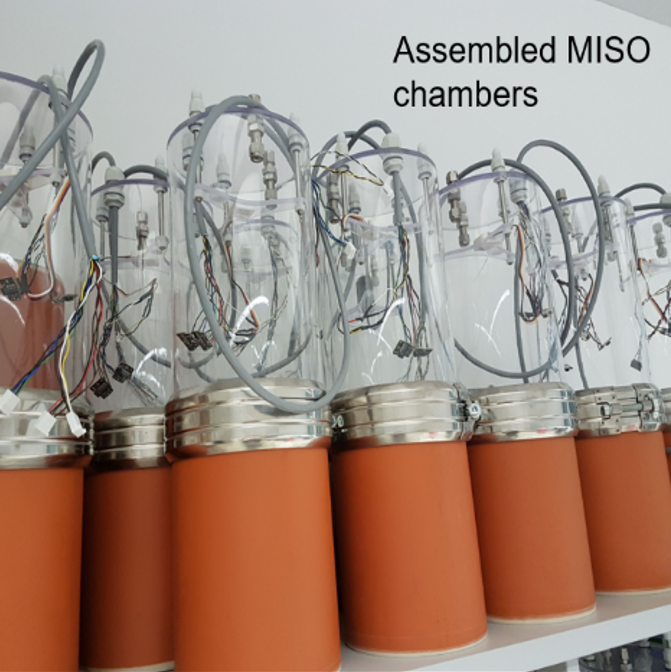
MISO gas chambers simplify the construction and deployment of these chamber systems and reduce the number of components with a goal of increasing portability and autonomy by producing cost-efficient and robust Gas flux chambers in terms of capital cost, deployment/recovery, and maintain leading that can be deployed in remote locations to improve geographical coverage and long-time series of in situ environmental observations. 

Key benefits:

• Working in harsh environmental conditions: novel autonomous gas flux measurement chambers, for first time, for hard-to-reach areas, thanks to temperature and humidity stabilization module and calibration module.

• Highly accurate sensor to measure CH4, CO2 and H2O

• Reduced costs: Cost-effective gas flux measurement chambers for purchasing, deployment and maintenance. Lower costs reduces risk of deployment.

• Improved temporal and spatial coverages: Guarantee long-term data capturing through energy efficient algorithm implementation and extremely low operative power consumption. The gas flux chambers can technically be mobile, increasing spatial and temporal measurement coverage

Characteristics:

Current automated and manual gas flux measurement chambers for measurements of CO2 and CH4 require many external components outside of the chambers: tubing to carry gas to and from the analyzers for CO2 and CH4, wires and batteries for power to open and close the chambers, to operate an internal fan to circulate air inside the chamber and to run the sensors for temperature and light. For measurements, there are small internal K96 sensors with external logger for temperature and light, multiplexers for directing gas flow to the analyzers in automated systems, and finally, the gas analyzers themselves, including the external housing when these are semi-permanently installed.

Contact Info

Dr. Tuan-Vu Cao, project coordinator. 
The Climate and Environmental Research Institute NILU.

This project has received funding from the European Union’s Horizon Europe research and innovation programme under Grant Agreement No. 101086541.